Why a Private Paarl Retreat Could Be One of the More Interesting Lifestyle Property Investments in the Cape Winelands
There is a growing category of property buyer who isn't looking for a conventional investment property.
They aren't necessarily searching for the highest rental yield.
They aren't necessarily looking for a property to renovate and resell.
And they aren't necessarily interested in buying a home that sits empty for most of the year.
Instead, they are looking for something much more interesting:
a property that can become a private retreat, lifestyle asset, wellness destination or highly curated hospitality venture — while still retaining the underlying value of the real estate itself. Take a look at this premium offering in the Cape Winelands: Villa for sale in Paarl
That is where certain properties in the Paarl countryside become particularly compelling.
And in my view, the opportunity becomes even more interesting when you look at what is happening globally in wellness, experiential travel and the way affluent buyers increasingly think about their homes.
The global wellness economy is changing what people want from property
Wellness is no longer simply about going to a spa for a weekend.
It has become a significant global economic sector influencing how people travel, where they live and what they are prepared to spend money on.
The Global Wellness Institute estimates that the global wellness economy reached US$6.8 trillion in 2024, having grown 7.9% in one year. It forecasts the sector reaching approximately US$9.8 trillion by 2029. Global Wellness Institute
More interestingly for property investors, wellness real estate was the fastest-growing wellness sector between 2019 and 2024, growing at an average annual rate of 19.5%. GWI expects it to remain the fastest-growing sector, with projected annual growth of around 15% through 2029. Global Wellness Institute
Wellness tourism is also substantial, reaching approximately US$894 billion in 2024, with GWI forecasting further strong growth. Global Wellness Institute
That tells us something important about property.
People are increasingly willing to spend money on places that make them feel better.
Not merely places where they sleep.
And this is where Paarl becomes particularly interesting
The Cape Winelands already possesses many of the ingredients that the global wellness traveller is seeking.
Nature.
Space.
Wine.
Food.
Outdoor activity.
Beautiful scenery.
Privacy.
Slow living.
Wellness experiences.
And increasingly, sophisticated hospitality.
The Cape Winelands doesn't have to manufacture an entirely new tourism proposition around wellness.
It already has much of the foundation.
Recent Cape Winelands visitor research by Wesgro recorded international visitors at 13.94% of visitors during January–June 2025, while domestic visitors accounted for 86.06%. Among domestic visitors, 72.25% originated from the Western Cape. Wesgro
That combination is important.
It means a potential retreat property doesn't necessarily have to rely exclusively on international tourists.
There is a substantial domestic and regional market capable of supporting weekend escapes, private retreats, celebrations, family gatherings and wellness experiences.
What makes a property like this interesting?
The attraction isn't simply the house.
It is the possibility of creating an experience around the property.
Depending on the property's configuration, a buyer could potentially explore concepts such as:
a private family retreat;
a luxury weekend escape;
a wellness retreat;
yoga and mindfulness weekends;
executive or leadership retreats;
intimate celebrations;
private culinary experiences;
small-scale destination events;
a creative residency;
a photography or content location;
a corporate off-site venue;
a private members' retreat;
or simply an exceptional second home.
The important word here is potential.
Any commercial use would still need to be assessed against the property's zoning, municipal requirements, title conditions, insurance, and any applicable estate, HOA or other property rules.
But that doesn't diminish the investment case.
It actually makes the due-diligence process more important.
I would look at this as a lifestyle asset first
One of the questions I increasingly think investors should ask themselves when considering experiential property is:
“Would I still want to own this property if I never generated a single night's rental income from it?”
If the answer is no, the investment may be overly dependent on a particular business model.
But if the answer is yes, the investment becomes fundamentally different.
Imagine owning a private retreat in the Paarl countryside that you can use yourself throughout the year.
You might spend long weekends there.
Host family.
Entertain friends.
Create a wellness programme.
Work remotely.
Use it as a private escape from Cape Town.
And potentially, subject to all applicable permissions, generate income from carefully selected uses when you aren't using it.
That is a very different proposition from simply buying a generic buy-to-let apartment.
The “private retreat” economy
There is also a psychological shift happening among affluent consumers.
The luxury traveller increasingly doesn't necessarily want more.
They want better.
Better sleep.
Better food.
More nature.
More privacy.
Less noise.
More meaningful experiences.
More time outdoors.
More space to disconnect.
GWI's recent wellness tourism research specifically identifies trends around integrative mental health, specialised sports rehabilitation, brain health, longevity travel and more accessible wellness tourism. Global Wellness Institute
That creates an interesting opportunity for properties where the physical environment itself is part of the product.
A beautiful bedroom is nice.
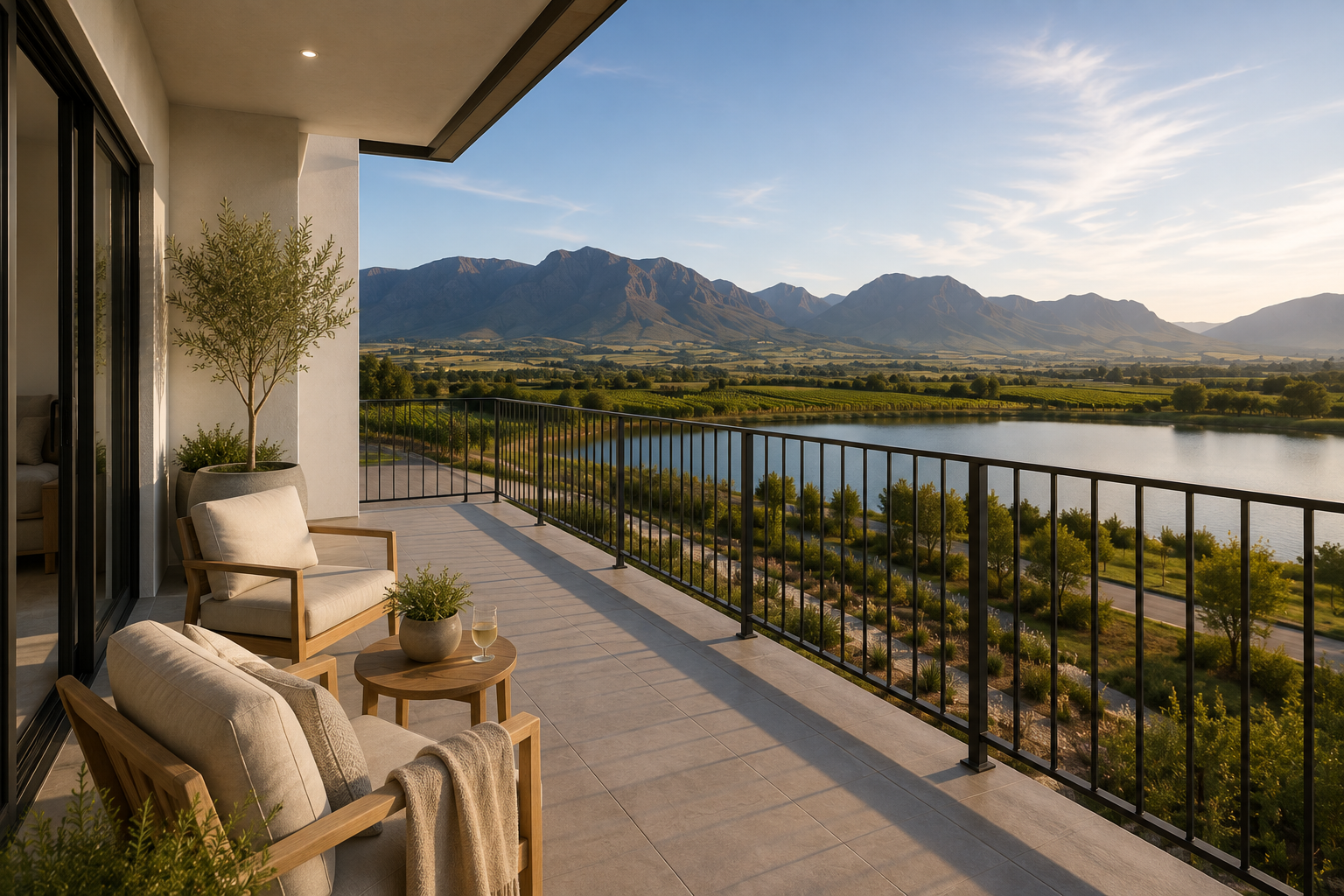
A beautiful bedroom overlooking mountains, vineyards or countryside, where guests can wake up, walk outside, exercise, eat locally sourced food and spend the afternoon in nature is a different experience. https://me.expsouthafrica.co.za/capeluxuryrealty/property/western-cape/villa/paarl-rural-paarl
And experiences command a different type of value.
Paarl has another advantage: it isn't only a tourism destination
This is something I think is sometimes overlooked when considering investment in the Winelands.
Paarl isn't exclusively dependent on tourism.
It is also a functioning town and an established residential market.
It sits within the wider Cape Winelands lifestyle economy while remaining connected to Cape Town, Stellenbosch, Franschhoek, Wellington and the broader Western Cape.
That creates several potential demand pools.
A retreat property could potentially appeal to:
The local market
For private celebrations, family gatherings, wellness days and weekend escapes.
The Cape Town market
For people looking for a relatively accessible countryside retreat.
The domestic luxury market
For buyers and travellers wanting a Winelands experience.
The international market
For travellers combining wine, food, nature and wellness.
The corporate market
For small executive retreats and private strategy sessions.
That diversity is attractive from an investment perspective.
The opportunity isn't necessarily to create another Airbnb
This is where I would make a very deliberate distinction from the current conversation around short-term rentals.
I wouldn't approach a property like this by asking:
“How much can I make per night on Airbnb?”
I would ask:
“What experience could this property become?”
That opens up a much broader investment conversation.
The future of experiential accommodation may not necessarily be about hundreds of anonymous bookings.
It could be about fewer guests, higher value, longer stays and more personalised experiences.
A property could potentially be marketed around:
wellness + nature + privacy + food + wine + experience.
That is a much more defensible proposition than simply competing with every other short-term rental on nightly price.
There is also an important investment principle here
Regulation around short-term accommodation is becoming more sophisticated.
Cape Town's proposed Short-Term Letting By-law is one example of how municipalities are beginning to formalise the sector, while property owners also need to consider HOA, Body Corporate, zoning and other restrictions.
That makes one investment principle increasingly important:
Don't buy an Airbnb. Buy a great property that happens to have multiple possible uses.
If the short-term rental model changes, the property should still make sense.
If tourism softens, you should still want to own it.
If you decide not to operate it commercially, it should still function as a valuable lifestyle asset.
And if demand for wellness and experiential travel continues to grow, you should have the opportunity to explore those markets.
That is a much stronger investment proposition.
Why the Cape Winelands fits the wellness trend so naturally
There is a reason wine estates and Winelands destinations are increasingly incorporating fitness, hiking, cycling, spas, healthy food and wellness experiences.
The destination already provides the ingredients.
A recent Cape Winelands industry report noted that wine farms are increasingly adding training facilities, walking and cycling trails, spas and wellness experiences as travellers increasingly combine wine and wellness. WineLand Media
The result is an increasingly sophisticated lifestyle proposition.
You can spend the morning walking through nature.
Have breakfast overlooking the mountains.
Visit a wine estate.
Enjoy a long lunch.
Return to your private retreat.
Swim.
Read.
Meditate.
Have dinner outside.
And wake up the next morning without feeling as though you have been on a conventional “holiday”.
That is precisely the kind of experience modern wellness tourism is increasingly selling.
For the right buyer, this could be more than a house
I think that is ultimately what makes this particular type of Paarl property interesting.
It isn't necessarily a conventional residential investment.
It is an opportunity to acquire a piece of the Winelands lifestyle and potentially build something around it.
For a private buyer, it could become a sanctuary.
For a family, a multi-generational retreat.
For an entrepreneur, potentially the foundation of a highly curated wellness or hospitality concept.
For an investor, potentially a property with several possible future exit strategies.
And for someone who wants to combine personal use with an income-generating venture, it could offer something particularly attractive:
the ability to enjoy the asset yourself while building a business around an environment people increasingly value.
The real question isn't “What can I rent it for?”
The more interesting question is:
“What could this property become?”
That is the question I would be asking before looking at spreadsheets.
Because the most compelling lifestyle-property opportunities are not always the properties with the obvious investment model.
Sometimes they are the properties where you can see several different futures.
A private retreat.
A wellness destination.
A luxury hospitality concept.
A family escape.
A corporate retreat.
Or simply an exceptional piece of the Cape Winelands that becomes more valuable as people increasingly prioritise space, nature, privacy and wellbeing.
The numbers still matter, of course.
So do zoning, permissions, operating costs, capital expenditure, insurance, financing and the property's eventual resale market.
But those should be evaluated after identifying the possibilities — not instead of them.
For investors looking at Paarl property investment, Cape Winelands lifestyle property, wellness real estate or a private retreat opportunity, this is exactly the kind of property I believe deserves a closer look.
Sometimes the best property investment isn't the one that produces the most immediate income. It is the one that gives you the greatest number of ways to create value.